
National
From Soldier to Target: Slade Douglas’s $30 Million Lawsuit Exposes America’s Darkest Playbook

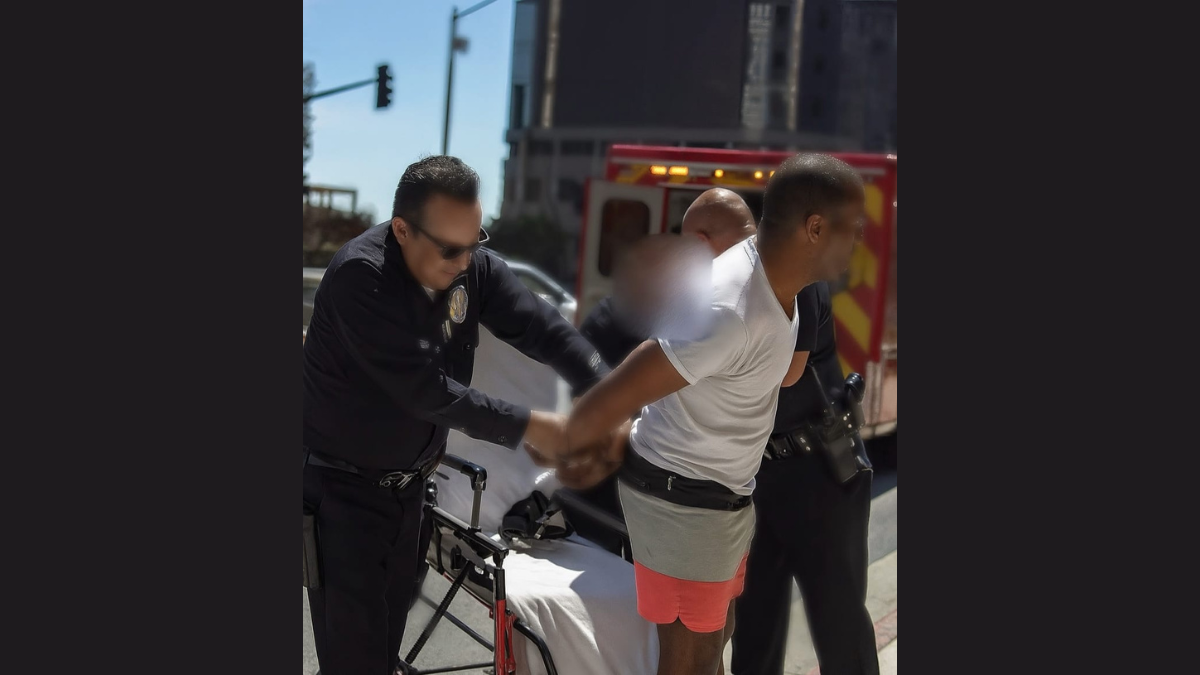
In the City of Angels, a cruel and unspeakable act was carried out under the color of law. Not in the shadows of tyranny abroad, but here, on American soil, against an American soldier, a hero who paid too far a price so that we could live in freedom, now at the center of a $30 million federal civil rights lawsuit.
His name is Slade Douglas. A man of honor, achievement, and service. In a case that strikes at the soul of American justice, a decorated Army veteran was falsely arrested, forcibly hospitalized, drugged, and sexually assaulted, tortured by LAPD Officers Jeremy R. Wheeler and Jeffrey H. Yabana.
The Honorable United States District Judge Maame Ewusi-Mensah Frimpong rejected the City’s attempt to dismiss the case in October 2023. She ruled that the officers violated the Constitution and the City is vicariously liable. She made it clear: this was not a lawful intervention. This was an abuse of power.
What happened to Slade Douglas was not a mental health intervention. It was a government-orchestrated swatting initiated by the VA in retaliation executed by state actors under color of law, using deception as a weapon and bureaucracy as a shield. It was a coordinated act of violence against a U.S. Army veteran. Not by foreign enemies. Not by rogue extremists. But by the very agencies charged with his care. And what followed was a state-sponsored assault so brutal, so unconstitutional, and so chilling, it calls into question whether any of us are truly safe.
The Court has already declared it: the officers did not act on evidence. They acted on vague hearsay, a second-hand message, unverified, unexamined, without context. And this finding places the officers’ conduct squarely within the constitutional violation identified by the United States Supreme Court in Florida v. J.L., 529 U.S. 266 (2000), which held that anonymous or unverified tips cannot justify police intrusion.
That alone destroys the claim that this was a lawful welfare check. For law without truth is not law at all.
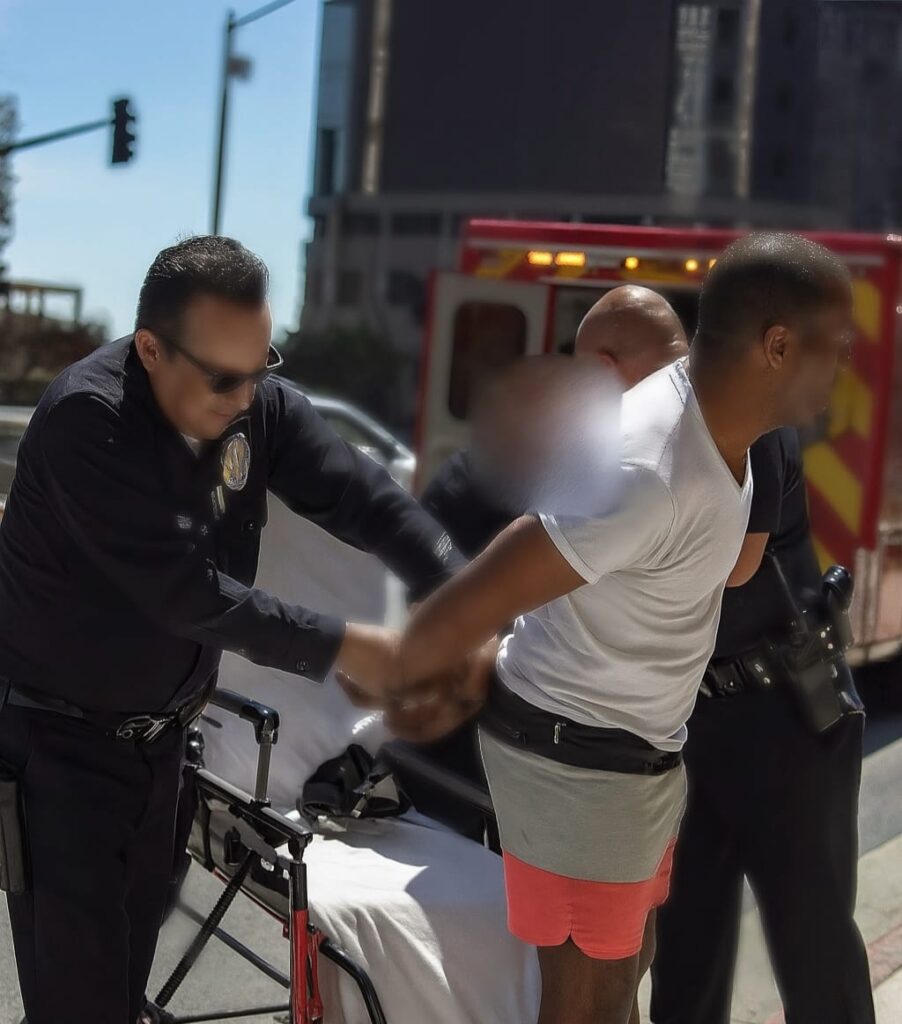
Douglas was targeted, not because he broke the law, but because he challenged it. He filed a discrimination complaint against the Veterans Administration. He sent it to the President of the United States. And when the Veterans Crisis Line called him, he called back, standing firm in his truth. That same complaint is now under investigation by the House Committee on Oversight and Reform.
So what did the government do? It retaliated. On August 27, 2019, the VA sent LAPD to his door under false pretenses. They called it a wellness check but it was a setup. A state-sanctioned swatting, documented in official VA records.
And when accountability approached, they turned to erasure. The National Archives and Records Administration confirmed it: the Veterans Crisis Line intentionally deleted the calls from that day, calls woven with false suicide claims, manufactured to conceal a state-sanctioned strike against a veteran who dared to speak.
They used government resources to silence a veteran.
There comes a time when the truth is so violent, so staggering, and so precise in its cruelty that to soften it would be a second crime. The case of Slade Douglas is such a truth. It is not a matter of perspective. It is not pending adjudication. It is the documented, judicially confirmed, and publicly recorded account of a constitutional atrocity, one carried out by sworn officers, sanctioned by silence, and initiated by the very government meant to protect him.
By any measure, Slade Douglas was the kind of man America claims to honor. A decorated U.S. Army veteran. A former law enforcement officer with an impeccable record. A dual-sport NCAA athlete with sub 4.2 speed. A 2001 BCS National Championship starting kick returner for Florida State. A Golden Gloves boxer. A holder of multiple black belts and college degrees. A man whose record should have made him a national example, not a target.
But on August 27, 2019, that record became irrelevant. That day, armed officers from LAPD, Jeremy R. Wheeler and Jeffrey H. Yabana, acting under color of law, stormed Douglas’s home without a warrant, without probable cause, and without legal justification.
Douglas had committed no crime. He had no criminal record. There was no warrant.
And yet, Slade Douglas was disappeared. He was forcibly handcuffed and removed from his home. After the arrest, Officer Wheeler told him that the “worst thing he could do was make a 911 call right in front of the officers” and that it was against the law. And as Officer Jeremy R. Wheeler himself admitted: Douglas was arrested for calling 911. That confession alone should send shivers down the spine of every American who believes in liberty. When the exercise of a constitutional right becomes a punishable offense, what remains of the Constitution? At that moment, the Constitution itself was taken hostage.
Slade Douglas states: “Calling a swatting a ‘welfare check’ is a false narrative.” It reframes a criminal and unconstitutional intrusion as an act of care. The law draws a bright line: When state actors act on false pretenses, knowingly or negligently, and violate constitutional safeguards, the conduct is not protective. It is punitive, retaliatory, and unlawful, no matter how the LAPD Officers Jeremy R. Wheeler and Jeffrey H. Yabana, the City of Los Angeles and their attorneys now try to frame it. Likewise, in Caniglia v. Strom, 141 S. Ct. 1596 (2021), the Supreme Court reaffirmed the constitutional boundaries of state intrusion and emphasized that state actors may not reframe or justify unconstitutional conduct under generalized doctrines such as community caretaking.
Judge Maame Ewusi-Mensah Frimpong set a precedent in the case of Slade Douglas vs. City of Los Angeles et al, where she declared, ‘The purpose of a welfare check is for the benefit of the individual at issue, not because they are under suspicion of any crime.’ Framing it otherwise is not supported by the record or the law, and reflects a fundamental misunderstanding of the constitutional limits on State power.
Douglas said. “I was arrested inside my own home. There was no warrant. No crime was witnessed. No lawful basis existed under Caniglia v. Strom, 141 S. Ct. 1596 (2021), and Payton v. New York, 445 U.S. 573 (1980), which requires one or the other. And Officer Wheeler himself stated. He arrested me for calling 911. Let that be fully understood: I exercised a lawful right, and I was punished for it. It was a constitutional violation from the start, rooted in deception, sustained by unlawful entry, and finalized by retaliation for engaging in a protected act. The Supreme Court made this clear in City of Houston v. Hill, 482 U.S. 451 (1987): “The government may not engage in conduct that chills the exercise of constitutional rights by labeling protected expression as dangerous or disorderly.”
Judge Maame Ewusi-Mensah Frimpong noted that “the defendants concede that Douglas was engaged in protected speech when he contacted 911 in their presence,” further stating that it is unconstitutional to evoke probable cause to take someone into custody under WIC 5150. It is an act of intellectual dishonesty and professional misconduct to deliberately frame such a case as a “mental health matter” or “5150 matter” when the facts and evidence made clear that no such framework ever applied. Too often, professionals who should know better repeat the State’s euphemisms. Words matter.
Slade Douglas said, “The City’s defense echoes a long history of weaponizing false classifications to justify abuse. In 1851, the desire of Black enslaved people to escape bondage was labeled a mental illness called drapetomania. It’s about how a false mental health label can be weaponized to strip away every right you thought you had. It is a blueprint, a government playbook: The government uses labels like “welfare check,” “a danger to self or others,” “public safety,” “mental health evaluation,” and “concern” as if they were magic words that nullify the Constitution.
That’s how they divide the public, not by law but by label, into two classes: those who are protected by the Constitution, and those who are managed outside of it.
It’s about how due process is no longer a guarantee, and how retaliation has replaced justice. The Constitution is not optional. There is no clause that allows the state to abandon liberty by renaming oppression. When language becomes a tool to erase rights, the Constitution is not upheld, it is betrayed.
Because if we allow those labels to replace legal standards, we invite a system where rights don’t depend on law, they depend on government discretion. And that’s not justice. That’s how the Constitution gets erased without ever being amended.”
What kind of nation punishes a citizen for asserting their right to be left alone, telling the police to leave again and again, and then, in fear, dialing 911 to report their refusal?
After being taken by force without legal justification, in the back of a patrol car, hands bound in cuffs, Douglas cried out in pain. His cries were met with laughter. The officers mocked his disability, dismissing his suffering as they tore at his dignity, piece by piece, as though it were theirs to take. The court noted, “It is well-established that any force applied without probable cause is a violation of constitutional rights.” This was no momentary lapse, no failure of judgment. It was a premeditated, calculated conspiracy against Douglas’s rights, planned and executed by Wheeler, Yabana, Sergeant Andrew Kang, and EMTs who confessed that their unconstitutional actions were done solely to shield the LAPD and the City from liability. They carried it out by forcibly transporting Douglas to the hospital against his will, against the law, and in defiance of the Constitution.
Maame Ewusi-Mensah Frimpong in her Findings of Fact concluded “Upon arriving at the hospital, Wheeler spoke with staff, and Douglas received treatment without his consent.” That is not an opinion, it is a fact established in federal court. And when there is no consent, every act that follows is unlawful. No amount of clinical language can wash the blood from an unconstitutional act.
It is a matter of judicial record that, with qualified immunity denied, 5150 authority rejected, and treatment without consent found as fact, LAPD’s arrest and forcible transport to the hospital constituted an unlawful seizure tantamount to kidnapping under color of law.
At PIH Good Samaritan Hospital, a facility contracted by the City, the nightmare deepened as Douglas was subjected to a horrific series of abuses. Based on Douglas’s sworn deposition, officers coerced staff into trying to find something in his system to justify the arrest, resulting in Douglas being forcibly injected with drugs while double handcuffed to a gurney, rendering him unconscious. Over the course of his captivity, he was injected nine times. Shackled in restraints, his limbs stretched out like a crucifixion, he was subjected to invasive blood draws, exhaustive toxicology tests, and brutal acts of sexual assault including forced catheterization. His cries and pleas for mercy were met with cold indifference and visible glee. This was torture, carried out under color of law. The hospital’s own records confirm it.
Once it was determined that Douglas had no drugs in his system, he was released from custody, not as a free man, but as a broken man. This was not an accident, nor an isolated abuse. It is part of the same blood-stained history as the Tuskegee syphilis experiment, the forced sterilizations Fannie Lou Hamer fought to expose, and the secret testing of chemical and biological agents on American veterans. One of the most shameful acts on U.S. soil, a deliberate assault on the body and dignity of a man who once wore this nation’s uniform.
If Congress doesn’t act, then we should stop pretending this is a country of laws. Because laws did not protect him. Policies did not protect him. His education did not protect him. His service to this nation did not protect him.
The case of Slade Douglas v. City of Los Angeles, et al. exposes the kind of systemic abuse so grave, so unlawful, and so violent that it reveals, in plain view, what this nation dares not admit about itself.
History teaches that whenever power is allowed to bypass the law, it becomes a weapon that can be turned on anyone.
This case is not about one man alone. It is about a system unchecked, a government unrepentant, and a nation at risk of forgetting its promise to protect the rights of the people, even those it once sent to war.
This isn’t about reform. This isn’t about training. And we already have the victim. The only thing missing is a country willing to admit what it has become. This is America.
Douglas is represented by civil rights attorneys Peter Carr, Lauren McRae, and Na’Shaun Neal.


PART I – EXECUTIVE OVERVIEW AND JURISDICTIONAL AUTHORITY
This investigative submission, grounded in the verified factual record of Douglas v. City of Los Angeles and in the constitutional rulings of the United States District Court for the Central District of California, exposes a coordinated and systemic deprivation of rights committed under color of law by the Los Angeles Police Department and municipal officials.
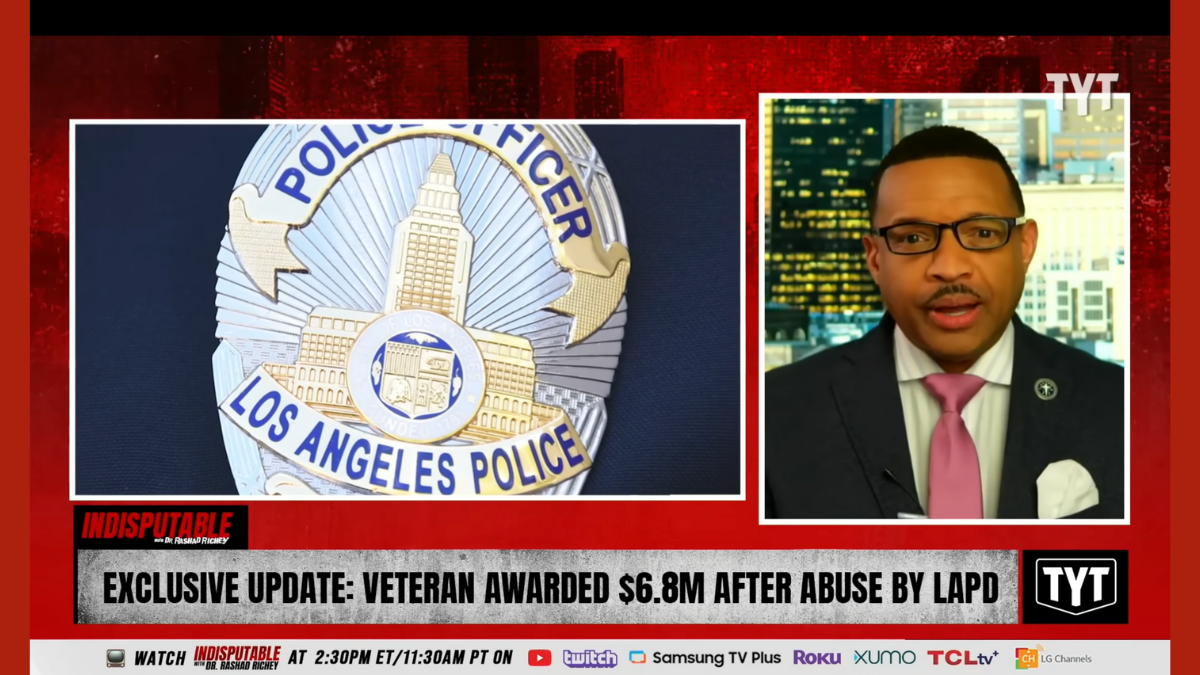
On December 23, 2025, Slade Douglas received a $6.8mm verdict against the Los Angeles Police Department.
In this document, based on Douglas’ extensive research, he advocates for the urgent need for Congress to legislate a bright-line rule: no entry or seizure may occur without warrant, judicial authorization, or verified evidence of imminent and articulable danger.
This analysis is based on extensive research by Slade Douglas, and integrates the full text of the publicly released Texas Metro News article titled “$30 Million Retaliation, Sexual Assault & Torture Case Against LAPD and City of Los Angeles Set for Trial December 8, 2025,” and every factual statement contained in this report is grounded in verifiable public evidence, not allegation.
The documentation includes sworn federal filings, contemporaneous hospital and police records, authenticated correspondence from the National Archives, and official judicial rulings issued by the United States District Court for the Central District of California.
All findings are supported by primary evidence already part of the public record or subject to federal disclosure requirements. Each citation aligns with established precedent and confirmed material proof, ensuring that this investigative report rests on incontrovertible fact, not interpretation.
Based on Douglas’ findings, this article demonstrates that the Controller’s report conceals unconstitutional activity behind medicalized language, erases judicial precedent, and perpetuates a system in which residents are seized, confined, and assaulted without probable cause. The matter rises to the level of federal criminal concern under 18 U.S.C. §§ 241, 242, and 1201, demanding congressional oversight and Department of Justice intervention.
PART II – FULL TEXT RECORD AND INTEGRATED FINDINGS
(Each paragraph of the original article is preserved verbatim, immediately followed by the corresponding constitutional findings.)
“LOS ANGELES — A U.S. Army veteran who once defended American freedom now finds himself fighting for it at home.”
Finding 1. Douglas explains that this line alone establishes the collapse of constitutional reciprocity: the State that once entrusted Douglas to defend liberty abroad turned its weapons inward. Through his analysis, Douglas asserts that the Controller’s report glorifies “public-safety interventions,” yet fails to acknowledge that such interventions, when divorced from evidence, become internal warfare against citizens.
“The case of Douglas v. City of Los Angeles has become one of the most disturbing civil-rights lawsuits … now at the center of a $30 million federal civil-rights lawsuit.”
Finding 2. Douglas says that the $30 million valuation reflects the measurable consequence of systemic constitutional breakdown. It quantifies not individual grievance but institutional failure. It is proof that when fundamental safeguards collapse, liability becomes the only remaining language of accountability.
“His name is Slade Douglas, a man of honor … falsely arrested, forcibly hospitalized, drugged, and sexually assaulted, tortured by LAPD Officers Jeremy R. Wheeler and Jeffrey H. Yabana.”
Finding 3. Douglas shows that each verb describes a separate felony under federal statute. “Arrested” without cause—false imprisonment; “forcibly hospitalized”—kidnapping under color of law; “drugged”—battery and chemical assault; “sexually assaulted”—violations of 18 U.S.C. § 242. The Controller’s report’s portrayal of “de-escalation” collapses when measured against these acts.
“The trial is scheduled for December 8, 2025 ….”
Finding 4. Douglas affirms that this is not a historic grievance but an active constitutional emergency awaiting adjudication. Delay itself constitutes ongoing harm because each day without reform validates the unlawful framework criticized herein.
“Judge Maame Ewusi-Mensah Frimpong rejected the City’s attempt to dismiss …”
Finding 5. Judicial denial of summary dismissal signifies judicial recognition of triable constitutional violations. Federal jurisdiction is firmly established.
“What the LAPD attempted to frame as a ‘welfare check,’ federal records confirm, was in fact a government-initiated swatting …”
Finding 6. (Primary Constitutional Finding). Labeling a retaliatory law-enforcement action as a “welfare check” constitutes semantic fraud and deprivation of due process. The City Controller’s report normalizes this abuse by equating warrantless entry with compassion. In Caniglia v. Strom, 141 S. Ct. 1596 (2021), the Supreme Court expressly rejected the “community-caretaking” doctrine as a license for home intrusion. The so-called “welfare check” used here is indistinguishable from the prohibited conduct in Caniglia and Payton v. New York, 445 U.S. 573 (1980).
Finding 6-A — Semantic Fraud and Systemic Inversion of Law
Douglas clearly illustrates that the City of Los Angeles and Los Angeles Police Department’s defense that officers were merely determining whether Douglas was a threat to himself or others is itself proof of semantic fraud. Under the Fourth Amendment, no seizure may occur without verified evidence of danger. As he points out, the record documents zero threats, weapons, or self-harm indicators. LAPD Officer Jeremy R. Wheeler told Sergeant Kang, “he starts calling 911 on his phone now he’s asking us to leave but like at that point I’m already there so I put him in handcuffs.” As Douglas explains that statement is not justification; it is confession — a direct admission against interest. It shows that Douglas was arrested solely for exercising his First Amendment right to call 911 and his Fourth Amendment right to demand officers leave his home.
When officers can claim authority to detain a citizen without evidence, and for invoking constitutional rights, the “welfare check” label becomes not a safeguard but a weapon of systemic abuse.
By invoking a false “mental health” narrative to justify the seizure, officials compounded the constitutional violation with defamation under color of law, branding an innocent veteran as mentally ill and dangerous to conceal their own misconduct.
Finding 6-B — Subjective Characterizations and the Manufacture of Danger
The City’s filings describe Douglas as “irate,” “completely irate,” “volatile,” “belligerent,” “agitated,” “upset,” “unstable,” and “non-compliant.”
When analyzing these words, Douglas explains how each word is interpretive, not factual. They record no crime, no resistance, and no danger. They only reflect the officer’s internal state, not Douglas’s conduct. They don’t establish evidence of a crime, threat, or resistance — only the officer’s subjective mindset.
Douglas shows this pattern of wording follows an institutional playbook—one that converts perception into legality. “When no crime exists, description becomes defense,” Douglas says. “When no threat exists, vocabulary is used to invent one.”
He shows that the officers are conditioned, both implicitly and explicitly through an institutional pattern reflected in repeated usage across reports and defenses, to transform ordinary human response into operational pretext: “irate” becomes hostility; “volatile” becomes risk; “non-compliant” becomes resistance. These labels serve two purposes—to justify force in the moment and to conceal misconduct afterward.
What Douglas stresses is that the playbook is simple and pervasive. It begins with linguistic escalation: insert adjectives that reframe how an officer felt about a person, not what actually happened, he explains.
Next comes narrative translation: memorialize those adjectives in the report to create a written record of supposed danger. Finally, invoke policy: present those words as objective indicators of risk, enabling the City to defend unlawful conduct as reasonable under departmental standards and argue that officers reasonably believed the individual was unstable or threatening.
What’s clear, Douglas says, is that distinction is not semantic; it means the difference between subjective interpretation (“how someone seemed — belligerent or irate”) and objective fact (“what someone did — commit a crime or make a threat”) isn’t just about wording or semantics — it’s the constitutional dividing line between a lawful police action and an illegal deprivation of liberty.
Douglas proceeds to explain that each descriptor operates as a substitute for facts:
• “Irate” converts lawful speech into perceived aggression.
• “Belligerent” turns a lawful assertion of rights into alleged aggression.
• “Volatile” creates danger where none existed.
• “Agitated” and “upset” convert emotional distress into supposed instability.
• “Unstable” converts perception into a false clinical label.
• “Non-compliant” transforms lawful objection into mental impairment.
“These are interpretive, not factual, descriptors — narrative devices used to justify force where the objective record offers no threat, resistance, or probable cause,” Douglas says.
Interpretive words are not facts — and not crimes, Douglas says.
• Being described as “irate” is not a violation of law.
• Appearing “belligerent” is not an offense.
• Being “volatile” or “agitated” is not probable cause.
• Seeming “upset” or “non-compliant” is not evidence of crime.
The institutional concealment begins with the report itself, Douglas explains. By embedding subjective terms into the official narrative, the record transforms from documentation into design. The adjectives do the work of omission: they erase context, silence contradiction, and redirect scrutiny away from the officer’s conduct and toward perception. Once in writing, these terms become the City’s evidence; once repeated in litigation, they become its defense. Thus, Douglas notes, the very language that created the violation becomes the shield that conceals it.
Demeanor is not probable cause. Under Terry v. Ohio, 392 U.S. 1 (1968), and Beck v. Ohio, 379 U.S. 89 (1964), intrusion requires specific and articulable facts showing crime or imminent threat. None appear here. No weapon was found, no violence alleged, no danger verified—only adjectives recycled from the same municipal lexicon used to justify thousands of similar intrusions across the city. The repetition is the evidence of policy: a linguistic mirage of danger to authorize what the law forbids.
“The National Archives and Records Administration later disclosed that the VCL intentionally deleted phone calls from that day, which contained false suicide allegations against Douglas.”
Finding 7. Intentional destruction of evidence constitutes obstruction of justice under 18 U.S.C. § 1519. This conduct nullifies the Controller’s confidence in data accuracy: when primary evidence is erased, accountability becomes impossible.
“The Court has already declared it: the officers did not act on evidence …”
Finding 8. This explicit judicial statement transforms policy failure into legal certainty: there was no evidence, only hearsay. Douglas asserts that the Controller’s report’s statistics—purporting success rates of MEU engagements—collapse when a single verified case demonstrates that the foundation itself violates constitutional prerequisites.
“By any measure, Slade Douglas was the kind of man America claims to honor. A U.S. Army veteran. A former law enforcement officer with an impeccable record. A dual-sport NCAA athlete with sub-4.2 speed. A Golden Gloves boxer. A holder of multiple black belts and college degrees, and national-championship football player. A man whose record should have made him a national example, not a target.”
Finding 9. Targeting a decorated veteran annihilates the notion that abuse is limited to “high-risk” individuals. “When a citizen of unimpeachable record is treated as expendable, no resident remains safe,” Douglas says.
“On August 27, 2019, … officers stormed Douglas’s home without a warrant, without probable cause, and without legal justification.”
Finding 10. What Douglas shows is that ahome is the constitutional fortress of privacy. Entry without judicial authorization, absent true exigency, is presumptively unlawful. Kentucky v. King, 563 U.S. 452 (2011), forbids officers from manufacturing exigency through their own actions. Here, Douglas shows, the “swatting” call created the façade of urgency—rendering the act a premeditated kidnapping.
“Douglas had committed no crime. He had no criminal record. There was no warrant.”
Finding 11. Douglas says that this case clearly shows that criminal defendants are presumed innocent and entitled to counsel; Douglas, accused of nothing, received neither. The inversion is stark: an innocent citizen subjected to greater coercion than a convicted felon.
“After the arrest … ‘the worst thing he could do was make a 911 call …’”
Finding 12. Through his analysis, Douglas explains that this admission converts the seizure into First-Amendment retaliation. Punishing emergency communication chills protected speech and endangers the entire public by deterring citizens from seeking aid.
“What followed, the record shows, was premeditated. Officers Wheeler and Yabana, joined by Sergeant Andrew Kang and EMTs who confessed, carried out a plan to transport Douglas to PIH Good Samaritan Hospital, a facility contracted by the City, “to protect the City and officers from liability.’”
Finding 13. This motive statement establishes corrupt intent: the City used medical detention as legal insulation. Says Douglas, “Every taxpayer thus subsidized obstruction of justice.”
“Once there, Wheeler spoke with staff, and as Judge Frimpong found as a fact in her ruling denying the City’s motion for summary judgment, Douglas received treatment without his consent.”
Finding 14. Douglas clearly explains that Judge Frimpong’s factual finding removes any dispute: absence of consent converts contact to battery. The City Controller’s framing of such detentions as “health interventions” is therefore a misrepresentation of criminal conduct as care.
PART II-B — CONTINUED INTEGRATION OF THE FULL ARTICLE AND FINDINGS
Douglas states that the hospital triage note is the defendants’ own admission, a contemporaneous admission against interest created in the ordinary course of hospital recordkeeping. It documents custody from intake, names the officers, records seizure from his home, relies only on hearsay speculation, acknowledges his denial of suicidality, notes back pain as his only complaint, memorializes his explicit refusal of care, and even states that ‘PD called EMS for medical clearance’ after a complaint of back pain.
Finding 15. When you read this written triage note, Douglas says, itconstitutes a self-authenticating admission under Federal Rule of Evidence 803(6). It is, in essence, the defendants’ confession in their own handwriting. Each phrase—“custody,” “refusal of care,” “medical clearance”—disproves any pretense of voluntariness. The document converts administrative negligence into evidence of intentional misconduct. Under 18 U.S.C. § 1519, falsifying or concealing material records during a federal investigation is obstruction; here, the record stands unaltered, indicting its authors.
“This is not an incidental entry; it reflects the very justification EMTs gave LAPD, that he had to be taken to the hospital to protect the officers and the City from liability. It operationalizes his custody with a location code and confirms that the process was never medical but a liability shield.”
Finding 16. Douglas points out thatliability avoidance is not a constitutional purpose. When officers transport a citizen for the exclusive benefit of their own legal protection, the act meets the mens rea for kidnapping under 18 U.S.C. § 1201.The Controller’s report praises “risk mitigation”; in practice, that phrase means coerced detention to insulate the City from civil liability—an illicit conversion of public authority to private defense.
“On the face of their own record, LAPD lacked probable cause (Beck v. Ohio, 379 U.S. 89 (1964)), violated the sanctity of the home (Payton v. New York, 445 U.S. 573 (1980)), acted on conjecture (Florida v. J.L., 529 U.S. 266 (2000)), disregarded statutory limits (People v. Triplett, 144 Cal. App. 3d 283 (1983)), and imposed forced confinement and assault against explicit refusal (Winston v. Lee, 470 U.S. 753 (1985); Rochin v. California, 342 U.S. 165 (1952)).”
Finding 17. There’s no doubt that each cited precedent forms a pillar of constitutional law, Douglas states. Collectively they constitute an indictment already rendered by the Supreme Court in principle. To violate all of them in one operation is to stage a constitutional collapse. The Controller’s report claims “compliance with best practices”; these cases prove that no practice that defies the Bill of Rights can be “best.”
“… the officers incriminated themselves in their own statements (‘for calling 911,’ ‘for not letting them finish their investigation’), and the hospital independently corroborated that custody in writing. Together, these admissions, made by the defendants themselves and corroborated by a neutral institution, leave no room for dispute: Douglas was unlawfully seized, confined, drugged, tortured, and sexually assaulted while under LAPD custody. No later justification can erase what the record itself proves.”
Finding 18. Douglas says these are judicially cognizable confessions. Under Miranda and its progeny, a statement against interest made voluntarily by state actors is admissible as proof of mens rea. The admissions establish that officers acted with knowledge of unlawfulness. The Controller’s statistical tables speak of “detentions for safety”; this record speaks of torture for liability control.
“What took place inside the hospital was not therapy,but evidence fabrication designed to retroactively justify an unlawful arrest.”
Finding 19. Douglas explains that the facts speak for themselves – and that there’s legal grounding for them. Fabricating a medical pretext after a seizure constitutes constructive fraud and obstruction of justice (18 U.S.C. §§ 1503, 1519). It transforms every clinician who participated into a state agent under West v. Atkins (487 U.S. 42 (1988)). The Controller’s assertion that MEU teams “divert people from jail” ignores that diversion to a hospital for evidence collection is merely jail by another name.
“… once consent is gone, the acts that followed are not medical treatment; they are analyzed as bodily seizures, assaults, and uses of force under color of law.”
Finding 20. Consent is the dividing line between care and crime. The Constitution does not cease at the hospital door. Cruzan v. Director, Missouri Dept. of Health (497 U.S. 261 (1990)) guarantees the right to refuse medical intervention. Every injection administered after refusal is a battery and use of force within the meaning of 18 U.S.C. § 242.
“Douglas was taken by force to PIH Good Samaritan Hospital, against his will, against the law, and in defiance of the Constitution, where the record shows he was chemically restrained and injected nine times while double handcuffed to a gurney.”
Finding 21. The number of injections—nine—demonstrates premeditation and cruelty. Under Rochin v. California (342 U.S. 165 (1952)), forced drugging to obtain evidence “shocks the conscience.” The Eighth Amendment’s ban on cruel and unusual punishment applies even more strongly when the victim is not an accused criminal but a citizen held without charge. The Controller’s data recording “chemical restraint usage” as a metric of success constitutes an audit of crimes.
“After Slade Douglas was drugged, his blood was extracted and tested. In law, a compelled blood draw is a search of the body under the Fourth Amendment (Skinner v. Railway Labor Executives’ Ass’n, 489 U.S. 602 (1989)).”
Finding 22. Take a clear look at the facts, Douglas says: “Compelled extraction without consent and without warrant is an unconstitutional search.” Skinner governs only when railway employees consent under statute; here, no such consent existed. The Controller’s report fails to mention that LAPD conducted zero judicial warrant applications for medical testing during the audit period—proof of institutional lawlessness.
“… Douglas did not consent, making the extraction a battery under California law … and an unreasonable search and seizure under federal law.”
Finding 23. This is a dual-sovereign violation: state battery and federal unreasonable search.Each officer is individually liable under 42 U.S.C. § 1983 and jointly liable under 18 U.S.C. § 242.
“The test’s stated purpose was not to diagnose or treat him but to ‘find something’ to justify the arrest.”
Finding 24. Investigatory purpose converts a medical procedure into a forensic search. Ferguson v. City of Charleston (532 U.S. 67 (2001)) held such testing unconstitutional.The Controller’s recommendation for expanded “data sharing between law enforcement and health partners” is therefore a proposal to expand unconstitutional search capacity.
“Urine was obtained through forced catheterization … It is defined as sexual assault and sexual battery by instrumentation under California Penal Code §§ 289 and 243.4.”
Finding 25. “This is rape by instrumentation under color of law,” Douglas says. “No municipal report that fails to acknowledge such acts should retain public credibility.” The Eighth Amendment and the Convention Against Torture both classify this conduct as torture.The Controller’s silence on sexual violence within detentions is institutional concealment.
“Because it was done to collect evidence, not to provide care, it cannot be framed as ‘catheterization’ in any lawful medical sense.”
Finding 26. There is no question in Douglas’ mind that the language itself is evidence of fraud. Says Douglas, “Words cannot convert a crime into a procedure.” The phrase “welfare check,” like “catheterization,” functions as an administrative euphemism that erases criminal reality. The Controller’s report relies on these linguistic coverings to sustain public trust while hiding constitutional violation.
“The blood and urine taken from him were then tested for drugs or substances.”
Finding 27. As Douglas explains, the absence of a criminal predicate renders these tests per se illegal.Each sample collected is tainted evidence under the Wong Sun v. United States (371 U.S. 471 (1963)) exclusionary rule.The Controller’s audit of “clinical outcomes” never accounts for tainted evidence or constitutional fruit of the poisonous tree.
“After being drugged, Douglas was connected to monitoring devices and confined under observation.”
Finding 28. Douglas makes it clear that continuous monitoring without consent is custody, not care.It constitutes false imprisonment and ongoing search.Under Cruzan, bodily autonomy remains absolute absent judicial order.The Controller’s metrics for “average hold duration” in 5150 cases mask an epidemic of coerced detention.
“When toxicology tests came back clean, Douglas was released, not vindicated but violated.”
Finding 29. Douglas makes a clear argument, explaining that exonerating results prove malicious intent. When state actors continue detention despite absence of evidence, the crime of malicious prosecution is complete. The Controller’s report omits all cases with clean results, thereby omitting proof of systemic fabrication.
⸻
PART III — FEDERAL CONSTITUTIONAL AND CRIMINAL DETERMINATIONS
Douglas wants to make it clear that there are constitutional and criminal impacts of this case. Here’s a listing of the critical issues:
1. Kidnapping Under Color of Law — The transport of Slade Douglas without warrant or probable cause meets the elements of 18 U.S.C. § 1201(c).
2. Deprivation of Rights (18 U.S.C. § 242) — Each forced injection, search, and sexual assault is a distinct count.
3. Conspiracy Against Rights (18 U.S.C. § 241) — Coordinated conduct between officers, EMTs, and hospital staff satisfies the agreement element.
4. Obstruction of Justice (18 U.S.C. § 1519) — Destruction of VCL records meets intent to impede a federal inquiry.
5. False Statements (18 U.S.C. § 1001) — Labeling a swatting as a “welfare check” constitutes a material falsehood in federal records.
6. Civil Pattern of Racketeering (RICO) — Systemic use of fraudulent classifications to obtain funding and avoid liability satisfies the continuity and enterprise requirements.
⸻
PART IV — FINDINGS ON THE FALSE LABEL OF “WELFARE CHECK”
When it comes to the term “welfare check”, Douglas explains that this term functions “as a linguistic end-run around the Fourth Amendment.” By rebranding an arrest as assistance, state actors extinguish probable cause requirements and erase the citizen’s status as rights-holder. This semantic maneuver is the most dangerous innovation in modern policing because it permits kidnapping and assault under the guise of care.
Douglas strongly advocates that congress must legislate a bright-line rule: no entry or seizure may occur without warrant, judicial authorization, or verified evidence of imminent and articulable danger.
“The phrase ‘welfare check’—as operationalized by the LAPD and mirrored in the Controller’s report—has become the 21st-century replacement for ‘reasonable suspicion,’” Douglas asserts. “It is the State’s euphemism for authority without evidence. When applied to a citizen in his home, it operates as an extra-constitutional loophole, erasing the presumption of innocence and transforming the government from protector to predator.”
⸻
PART V — FINDINGS AND DETERMINATION
Finding 30 — Manufactured Exigency and the Death of Due Process
In Douglas v. City of Los Angeles, the record shows no emergency, no verification, and no threat—only manufactured exigency. Kentucky v. King (563 U.S. 452 (2011)) forbids police from creating the exigent circumstances they later invoke. Yet the LAPD did precisely that. The Controller’s report hails “rapid response to perceived crises” as best practice; in truth, it codifies a process by which officers can invent a crisis, burst into a home, and claim immunity after the fact. That practice is not “community care”—it is state-sponsored kidnapping.
Finding 31 — Unlawful Delegation of Mental-Health Authority
What truly outrages Douglas is that by allowing law-enforcement officers to initiate 5150 detentions without independent medical verification, Los Angeles has effectively deputized police as psychiatrists. This fusion of coercive power and medical pretext is unconstitutional. The Controller’s own audit admits that 97 percent of such detentions are police-initiated and fewer than 1 percent yield any criminal charge. Those numbers are the statistical fingerprint of systemic abuse.
Equal Protection and Systemic Bias
Douglas’ research shows that with 86 percent of all 5150 detentions imposed on people of color, selective enforcement is statistically irrefutable. The pattern meets the threshold for Department of Justice pattern-or-practice prosecution under 34 U.S.C. § 12601.
Finding 32 — Evidence of Intent and Retaliation
Douglas clearly shows that the retaliatory motive is documented: the VA’s deleted recordings, the officers’ statements (“for calling 911”), and the hospital’s record of explicit refusal. When officials conspire to erase evidence and punish speech, they cross from negligence into criminal intent. The pattern mirrors Hartman v. Moore(547 U.S. 250 (2006)): retaliation for protected speech under the First Amendment, carried out under color of law.
Finding 33 — Erosion of the Presumption of Innocence
Douglas explains that a criminal suspect is guaranteed Miranda rights, counsel, arraignment, and judicial oversight. Under a “welfare check,” none of those protections apply. The citizen is rendered rightless—subject to confinement, drugging, and assault without charge or hearing. This inversion—where an accused criminal enjoys more rights than a law-abiding citizen—represents the most profound constitutional regression since Korematsu. The presumption of innocence cannot coexist with preventive detention by label.
Finding 33-A — Criminalization of Innocence Through Compelled Compliance
What Douglas further emphasizes is that the “welfare check” framework transforms constitutional protection into entrapment. “When a citizen is told they are ‘under arrest’ absent any crime or probable cause, the law leaves them no safe recourse,” Douglas clearly explains. “If they comply, they are unlawfully detained; if they protest, they can be charged with resisting arrest. This inversion of justice converts innocence into liability and transforms the right to stand one’s ground into a pretext for violence. It is a system in which unlawful commands manufacture their own justification—a closed loop of coercion that endangers every American who dares to question unlawful authority.”
What Douglas’ case proves is that the record exposes a systemic inversion of law: when police lack evidence to arrest a suspect of an actual crime, constitutional safeguards prevent them from acting. Yet under the “welfare check” label, those same officers claim unchecked authority to detain, seize, and confine citizens who have committed no offense.
Finding 34 — Constitutional Supremacy over Administrative Policy
The City Controller’s report frames these intrusions as “policy successes.” The Constitution regards them as felonies. Rochin, Payton, Beck, Cruzan, Ferguson, and Caniglia collectively hold that bodily autonomy, home privacy, and due process are non-derogable rights. No municipal policy can rewrite those rulings. Any official who authorizes or funds such practices acts in knowing defiance of settled law.
Finding 35 — Pattern of Cover-Up and Fiscal Complicity
Says Douglas, “Each taxpayer dollar used to defend or conceal these acts deepens the government’s complicity. Public funds have been expended not to uphold the law but to perpetuate a scheme of concealment and retaliation.”
Under 18 U.S.C. § 371, conspiring to defraud the United States includes obstructing citizens’ constitutional rights under the guise of public administration. The City’s continuing defense converts budget appropriation into criminal enterprise.
Finding 36 — National Implications and Federal Interest
Douglas explains that because the Department of Veterans Affairs triggered the false report, this case transcends local jurisdiction. Federal actors, city police, and contracted hospitals formed an inter-agency conspiracy that implicates the Fourteenth Amendment’s Equal Protection Clause and 18 U.S.C. §§ 241–242. The facts require intervention by the Department of Justice, the Civil Rights Division, and Congress to impose federal standards preventing further constitutional collapse.
PART VI — CONSTITUTIONAL ACCOUNTABILITY AND PUBLIC WARNING
Douglas offers a strong, clear and urgent warning to the public.
“The combined evidentiary record establishes probable cause for federal prosecution under 18 U.S.C. §§ 241, 242, 1201, and 1519, and mandates immediate review by the Civil Rights Division and Congressional Oversight Committees,” he asserts. “The evidence is sufficient for DOJ referral, grand-jury consideration, and national policy reform to restore constitutional supremacy over administrative pretext. These acts are not isolated misconduct but a systemic policy failure disguised as “mental-health intervention,” the very definition of semantic fraud and systemic inversion of law.”
Douglas offers this warning: The next “welfare check” could be at their own door, a universal civil-liberties warning and a national public-safety issue. As he states, “The only safeguard is law applied without exception and without delay: the Constitution over administrative pretext.”
• Douglas Documentary – “The Veteran They Tried to Silence”
• PDF – “Slade Douglas Swatted by Veteran Affairs” – Official Document Archive
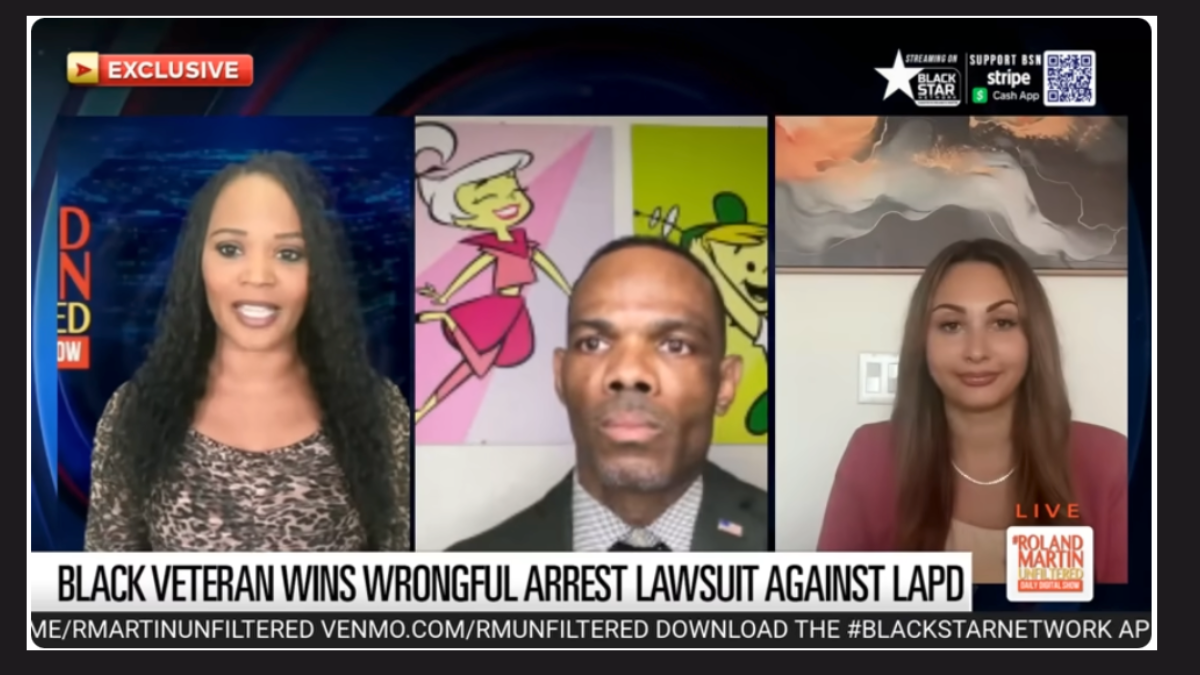
LOS ANGELES, Dec. 30, 2025 — A $6.8 million jury verdict has been rendered in favor of Slade Douglas. A man of honor, achievement, and service, the veteran was swatted by the VA, falsely arrested by LAPD Officers Jeremy R. Wheeler and Jeffrey H. Yabana, and subsequently subjected to forced hospitalization, drugging, and sexual assault.
“This verdict affirms that constitutional rights are not optional,” said Peter L. Carr IV, counsel for Slade Douglas.
The Honorable United States District Judge Maame Ewusi-Mensah Frimpong presided over the case.
What the LAPD attempted to frame as a “welfare check,” was in fact a government-initiated swatting, triggered according to evidence by a retaliatory call from the U.S. Department of Veterans Affairs after Douglas filed a discrimination complaint against the agency.
The National Archives and Records Administration later disclosed that the VCL intentionally deleted phone calls from that day, which contained false suicide allegations against Douglas.
By any measure, Slade Douglas was the kind of man America claims to honor. A U.S. Army veteran. A former law-enforcement officer with an impeccable record. A dual-sport NCAA athlete with sub-4.2 speed. A Golden Gloves boxer. A holder of multiple black belts and college degrees. A national-championship football player. A man whose record should have made him a national example, not a target.
But on August 27, 2019, that record became irrelevant. That day, armed officers from LAPD, Jeremy R. Wheeler and Jeffrey H. Yabana, acting under color of law, stormed Douglas’s home without a warrant, without probable cause, and without legal justification.
Douglas had committed no crime. He had no criminal record. There was no warrant.
And yet, Slade Douglas was disappeared. He was forcibly handcuffed and removed from his home. After the arrest, Officer Wheeler told him that the “worst thing he could do was make a 911 call right in front of the officers” and that it was against the law. And as Officer Jeremy R. Wheeler himself admitted: Douglas was arrested for calling 911.
What followed was premeditated. Officers Wheeler and Yabana, joined by Sergeant Andrew Kang and EMTs who confessed, carried out a plan to transport Douglas to PIH Good Samaritan Hospital, a facility contracted by the City, “to protect the City and officers from liability.”
At PIH Good Samaritan Hospital, Douglas was subjected to a horrific series of abuses. Officers coerced hospital staff into trying to find something in his system to justify the arrest, resulting in Douglas being forcibly injected with drugs while double handcuffed to a gurney, rendering him unconscious. Over the course of his captivity, he was injected nine times. Shackled in restraints, his limbs stretched out like a crucifixion, he was subjected to invasive blood draws, exhaustive toxicology tests, and brutal acts of sexual assault including forced catheterization. This was torture, carried out under color of law.
Once it was determined that Douglas had no drugs in his system, he was released from custody. This was not an accident, nor an isolated abuse.
What took place inside the hospital was not therapy but evidence fabrication designed to retroactively justify an unlawful arrest.
Douglas’s story is also the subject of a feature documentary, Slade Douglas v. City of Los Angeles — The Veteran They Tried to Silence, available at http://www.youtube.com/watch?v=X1Q99Er0n0Y.
Douglas is represented by civil-rights attorneys Peter Carr, Lauren McRae, and Na’Shaun Neal.
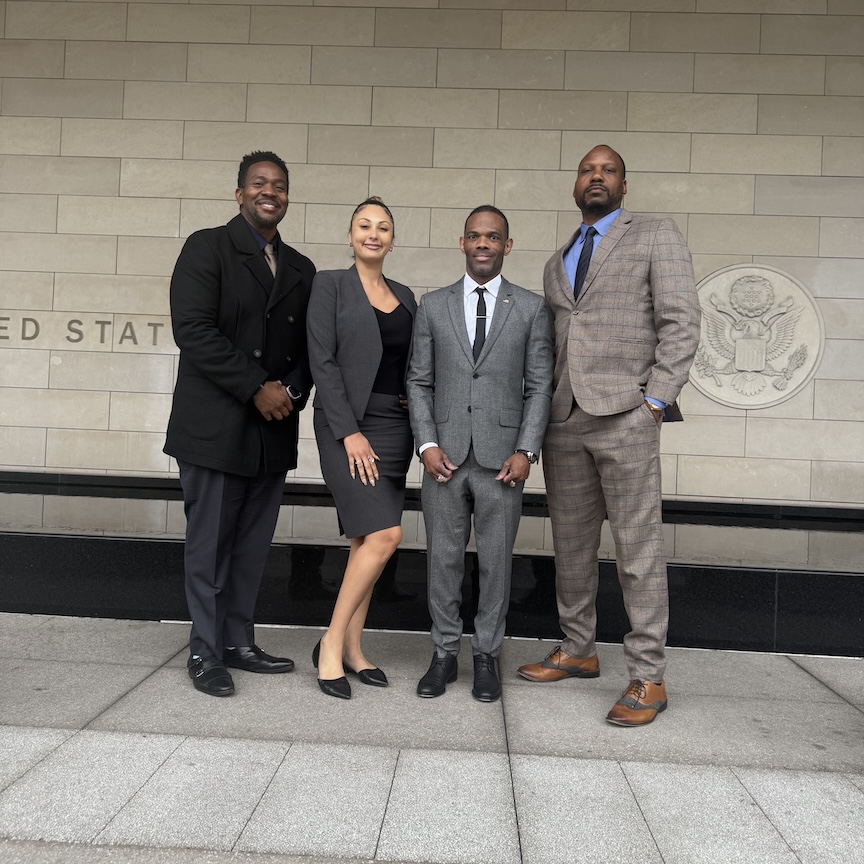
Legal team pictured (l. to r.) Na’Shaun Neal, Lauren McRae, Slade Douglas and Peter Carr


Dr. Rashad Richey Offers Exclusive Analysis on Veteran Slade Douglas $6.8mm Verdict

Slade Douglas Offers Detailed Analysis of Case


