National
From Soldier to Target: Slade Douglas’s $30 Million Lawsuit Exposes America’s Darkest Playbook

In the City of Angels, a cruel and unspeakable act was carried out under the color of law. Not in the shadows of tyranny abroad, but here, on American soil, against an American soldier, a hero who paid too far a price so that we could live in freedom, now at the center of a $30 million federal civil rights lawsuit.
His name is Slade Douglas. A man of honor, achievement, and service. In a case that strikes at the soul of American justice, a decorated Army veteran was falsely arrested, forcibly hospitalized, drugged, and sexually assaulted, tortured by LAPD Officers Jeremy R. Wheeler and Jeffrey H. Yabana.
The Honorable United States District Judge Maame Ewusi-Mensah Frimpong rejected the City’s attempt to dismiss the case in October 2023. She ruled that the officers violated the Constitution and the City is vicariously liable. She made it clear: this was not a lawful intervention. This was an abuse of power.
What happened to Slade Douglas was not a mental health intervention. It was a government-orchestrated swatting initiated by the VA in retaliation executed by state actors under color of law, using deception as a weapon and bureaucracy as a shield. It was a coordinated act of violence against a U.S. Army veteran. Not by foreign enemies. Not by rogue extremists. But by the very agencies charged with his care. And what followed was a state-sponsored assault so brutal, so unconstitutional, and so chilling, it calls into question whether any of us are truly safe.
The Court has already declared it: the officers did not act on evidence. They acted on vague hearsay, a second-hand message, unverified, unexamined, without context. And this finding places the officers’ conduct squarely within the constitutional violation identified by the United States Supreme Court in Florida v. J.L., 529 U.S. 266 (2000), which held that anonymous or unverified tips cannot justify police intrusion.
That alone destroys the claim that this was a lawful welfare check. For law without truth is not law at all.

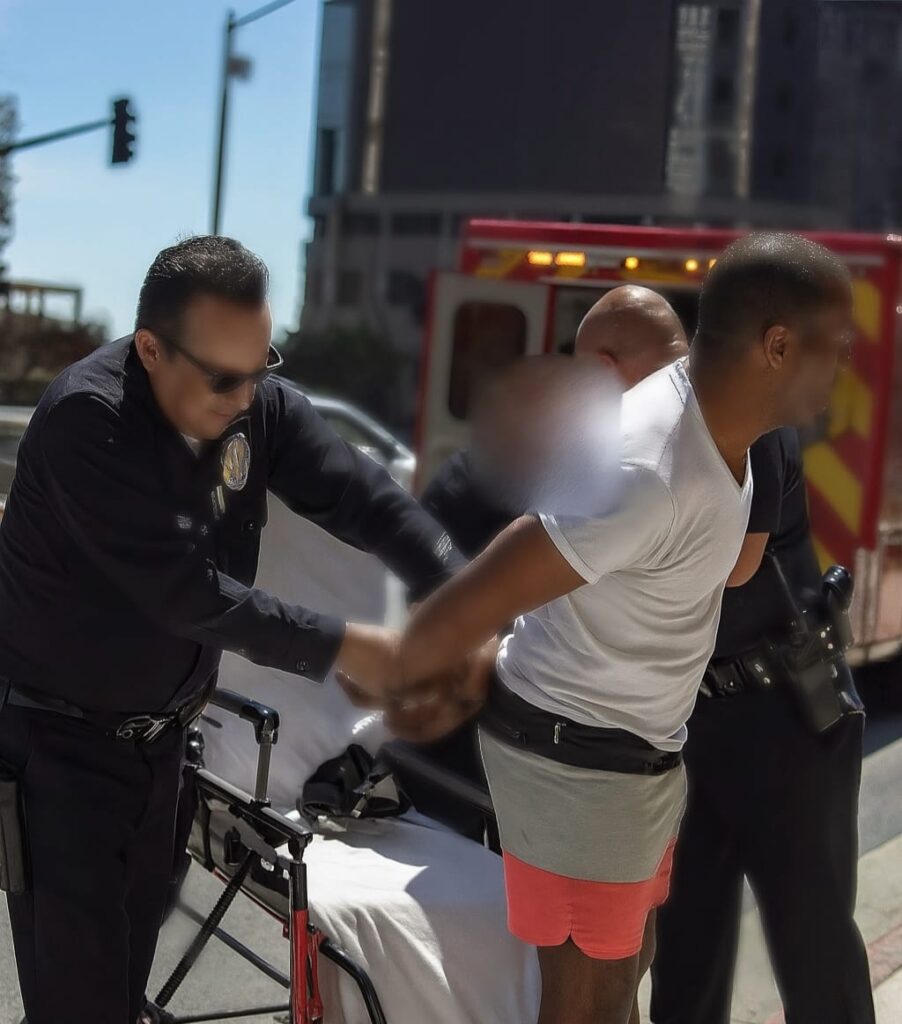
Douglas was targeted, not because he broke the law, but because he challenged it. He filed a discrimination complaint against the Veterans Administration. He sent it to the President of the United States. And when the Veterans Crisis Line called him, he called back, standing firm in his truth. That same complaint is now under investigation by the House Committee on Oversight and Reform.
So what did the government do? It retaliated. On August 27, 2019, the VA sent LAPD to his door under false pretenses. They called it a wellness check but it was a setup. A state-sanctioned swatting, documented in official VA records.
And when accountability approached, they turned to erasure. The National Archives and Records Administration confirmed it: the Veterans Crisis Line intentionally deleted the calls from that day, calls woven with false suicide claims, manufactured to conceal a state-sanctioned strike against a veteran who dared to speak.
They used government resources to silence a veteran.
There comes a time when the truth is so violent, so staggering, and so precise in its cruelty that to soften it would be a second crime. The case of Slade Douglas is such a truth. It is not a matter of perspective. It is not pending adjudication. It is the documented, judicially confirmed, and publicly recorded account of a constitutional atrocity, one carried out by sworn officers, sanctioned by silence, and initiated by the very government meant to protect him.
By any measure, Slade Douglas was the kind of man America claims to honor. A decorated U.S. Army veteran. A former law enforcement officer with an impeccable record. A dual-sport NCAA athlete with sub 4.2 speed. A 2001 BCS National Championship starting kick returner for Florida State. A Golden Gloves boxer. A holder of multiple black belts and college degrees. A man whose record should have made him a national example, not a target.
But on August 27, 2019, that record became irrelevant. That day, armed officers from LAPD, Jeremy R. Wheeler and Jeffrey H. Yabana, acting under color of law, stormed Douglas’s home without a warrant, without probable cause, and without legal justification.
Douglas had committed no crime. He had no criminal record. There was no warrant.
And yet, Slade Douglas was disappeared. He was forcibly handcuffed and removed from his home. After the arrest, Officer Wheeler told him that the “worst thing he could do was make a 911 call right in front of the officers” and that it was against the law. And as Officer Jeremy R. Wheeler himself admitted: Douglas was arrested for calling 911. That confession alone should send shivers down the spine of every American who believes in liberty. When the exercise of a constitutional right becomes a punishable offense, what remains of the Constitution? At that moment, the Constitution itself was taken hostage.
Slade Douglas states: “Calling a swatting a ‘welfare check’ is a false narrative.” It reframes a criminal and unconstitutional intrusion as an act of care. The law draws a bright line: When state actors act on false pretenses, knowingly or negligently, and violate constitutional safeguards, the conduct is not protective. It is punitive, retaliatory, and unlawful, no matter how the LAPD Officers Jeremy R. Wheeler and Jeffrey H. Yabana, the City of Los Angeles and their attorneys now try to frame it. Likewise, in Caniglia v. Strom, 141 S. Ct. 1596 (2021), the Supreme Court reaffirmed the constitutional boundaries of state intrusion and emphasized that state actors may not reframe or justify unconstitutional conduct under generalized doctrines such as community caretaking.
Judge Maame Ewusi-Mensah Frimpong set a precedent in the case of Slade Douglas vs. City of Los Angeles et al, where she declared, ‘The purpose of a welfare check is for the benefit of the individual at issue, not because they are under suspicion of any crime.’ Framing it otherwise is not supported by the record or the law, and reflects a fundamental misunderstanding of the constitutional limits on State power.
Douglas said. “I was arrested inside my own home. There was no warrant. No crime was witnessed. No lawful basis existed under Caniglia v. Strom, 141 S. Ct. 1596 (2021), and Payton v. New York, 445 U.S. 573 (1980), which requires one or the other. And Officer Wheeler himself stated. He arrested me for calling 911. Let that be fully understood: I exercised a lawful right, and I was punished for it. It was a constitutional violation from the start, rooted in deception, sustained by unlawful entry, and finalized by retaliation for engaging in a protected act. The Supreme Court made this clear in City of Houston v. Hill, 482 U.S. 451 (1987): “The government may not engage in conduct that chills the exercise of constitutional rights by labeling protected expression as dangerous or disorderly.”
Judge Maame Ewusi-Mensah Frimpong noted that “the defendants concede that Douglas was engaged in protected speech when he contacted 911 in their presence,” further stating that it is unconstitutional to evoke probable cause to take someone into custody under WIC 5150. It is an act of intellectual dishonesty and professional misconduct to deliberately frame such a case as a “mental health matter” or “5150 matter” when the facts and evidence made clear that no such framework ever applied. Too often, professionals who should know better repeat the State’s euphemisms. Words matter.
Slade Douglas said, “The City’s defense echoes a long history of weaponizing false classifications to justify abuse. In 1851, the desire of Black enslaved people to escape bondage was labeled a mental illness called drapetomania. It’s about how a false mental health label can be weaponized to strip away every right you thought you had. It is a blueprint, a government playbook: The government uses labels like “welfare check,” “a danger to self or others,” “public safety,” “mental health evaluation,” and “concern” as if they were magic words that nullify the Constitution.
That’s how they divide the public, not by law but by label, into two classes: those who are protected by the Constitution, and those who are managed outside of it.
It’s about how due process is no longer a guarantee, and how retaliation has replaced justice. The Constitution is not optional. There is no clause that allows the state to abandon liberty by renaming oppression. When language becomes a tool to erase rights, the Constitution is not upheld, it is betrayed.
Because if we allow those labels to replace legal standards, we invite a system where rights don’t depend on law, they depend on government discretion. And that’s not justice. That’s how the Constitution gets erased without ever being amended.”
What kind of nation punishes a citizen for asserting their right to be left alone, telling the police to leave again and again, and then, in fear, dialing 911 to report their refusal?
After being taken by force without legal justification, in the back of a patrol car, hands bound in cuffs, Douglas cried out in pain. His cries were met with laughter. The officers mocked his disability, dismissing his suffering as they tore at his dignity, piece by piece, as though it were theirs to take. The court noted, “It is well-established that any force applied without probable cause is a violation of constitutional rights.” This was no momentary lapse, no failure of judgment. It was a premeditated, calculated conspiracy against Douglas’s rights, planned and executed by Wheeler, Yabana, Sergeant Andrew Kang, and EMTs who confessed that their unconstitutional actions were done solely to shield the LAPD and the City from liability. They carried it out by forcibly transporting Douglas to the hospital against his will, against the law, and in defiance of the Constitution.
Maame Ewusi-Mensah Frimpong in her Findings of Fact concluded “Upon arriving at the hospital, Wheeler spoke with staff, and Douglas received treatment without his consent.” That is not an opinion, it is a fact established in federal court. And when there is no consent, every act that follows is unlawful. No amount of clinical language can wash the blood from an unconstitutional act.
It is a matter of judicial record that, with qualified immunity denied, 5150 authority rejected, and treatment without consent found as fact, LAPD’s arrest and forcible transport to the hospital constituted an unlawful seizure tantamount to kidnapping under color of law.
At PIH Good Samaritan Hospital, a facility contracted by the City, the nightmare deepened as Douglas was subjected to a horrific series of abuses. Based on Douglas’s sworn deposition, officers coerced staff into trying to find something in his system to justify the arrest, resulting in Douglas being forcibly injected with drugs while double handcuffed to a gurney, rendering him unconscious. Over the course of his captivity, he was injected nine times. Shackled in restraints, his limbs stretched out like a crucifixion, he was subjected to invasive blood draws, exhaustive toxicology tests, and brutal acts of sexual assault including forced catheterization. His cries and pleas for mercy were met with cold indifference and visible glee. This was torture, carried out under color of law. The hospital’s own records confirm it.
Once it was determined that Douglas had no drugs in his system, he was released from custody, not as a free man, but as a broken man. This was not an accident, nor an isolated abuse. It is part of the same blood-stained history as the Tuskegee syphilis experiment, the forced sterilizations Fannie Lou Hamer fought to expose, and the secret testing of chemical and biological agents on American veterans. One of the most shameful acts on U.S. soil, a deliberate assault on the body and dignity of a man who once wore this nation’s uniform.
If Congress doesn’t act, then we should stop pretending this is a country of laws. Because laws did not protect him. Policies did not protect him. His education did not protect him. His service to this nation did not protect him.
The case of Slade Douglas v. City of Los Angeles, et al. exposes the kind of systemic abuse so grave, so unlawful, and so violent that it reveals, in plain view, what this nation dares not admit about itself.
History teaches that whenever power is allowed to bypass the law, it becomes a weapon that can be turned on anyone.
This case is not about one man alone. It is about a system unchecked, a government unrepentant, and a nation at risk of forgetting its promise to protect the rights of the people, even those it once sent to war.
This isn’t about reform. This isn’t about training. And we already have the victim. The only thing missing is a country willing to admit what it has become. This is America.
Douglas is represented by civil rights attorneys Peter Carr, Lauren McRae, and Na’Shaun Neal.